

Anticipate and ensure compliance
with the EU AI act and GDPR
Secure your AI projects against regulatory requirements and
reduce legal and reputational risks.

How to turn compliance into a competitive advantage?
With the EU AI act now in force and stricter GDPR enforcement, organizations must now:

Identify and classify
their AI systems by risk level (prohibited, high risk, limited, minimal).

Document and justify
each use case to
prove compliance to authorities.

Continuously adapt
their processes to incorporate regulatory updates.
Major risks:
- Financial and legal penalties:
Non-compliance fines under the EU AI act can reach 6% of global revenue (or €30 million), not including GDPR lawsuits.
- Loss of trust:
Lack of transparency or compliance failures expose companies to reputational crises, especially in regulated sectors (healthcare, finance, energy).
- Operational complexity:
Without dedicated tools, manually managing audits, registries, and regulatory updates becomes unmanageable, slowing innovation.

Our solution:
An automated, scalable compliance framework
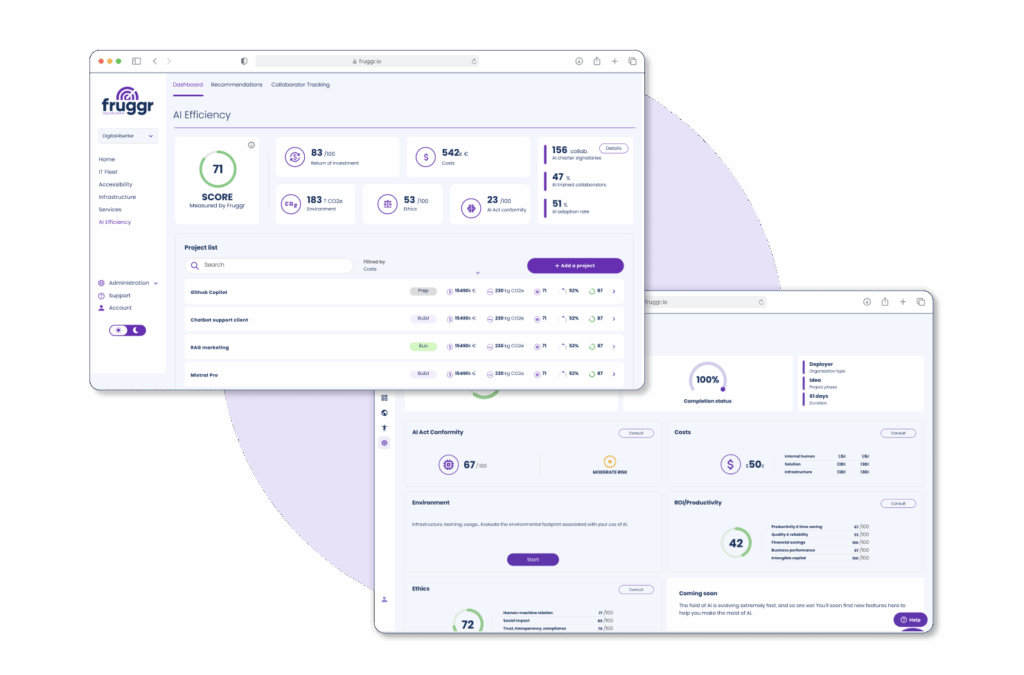
Fruggr helps you anticipate and manage the compliance of your AI systems,
aligning them with the EU AI act, GDPR, and your internal policies.
Key features
- Regulatory mapping:
Automatically classify your AI systems according to EU AI act risk categories,
with gap analysis.
- Centralized AI registry:
Document and track each model, use case, and decision to meet legal requirements
(articles 52, 53, 60 of the EU AI act).
- Alerts and updates:
Receive real-time notifications on regulatory changes and required corrective actions.
- Audit evidence:
Generate compliance reports ready for authorities (CNIL, European Commission)
or internal auditors.
Your benefits

Guaranteed compliance:
Avoid penalties by aligning your projects with legal requirements, with continuous and proactive monitoring.

Risk reduction:
Limit legal and reputational exposure through comprehensive documentation and validated processes.

Faster project deployment:
Accelerate your AI solutions by automating compliance checks and reducing regulatory bottlenecks.
