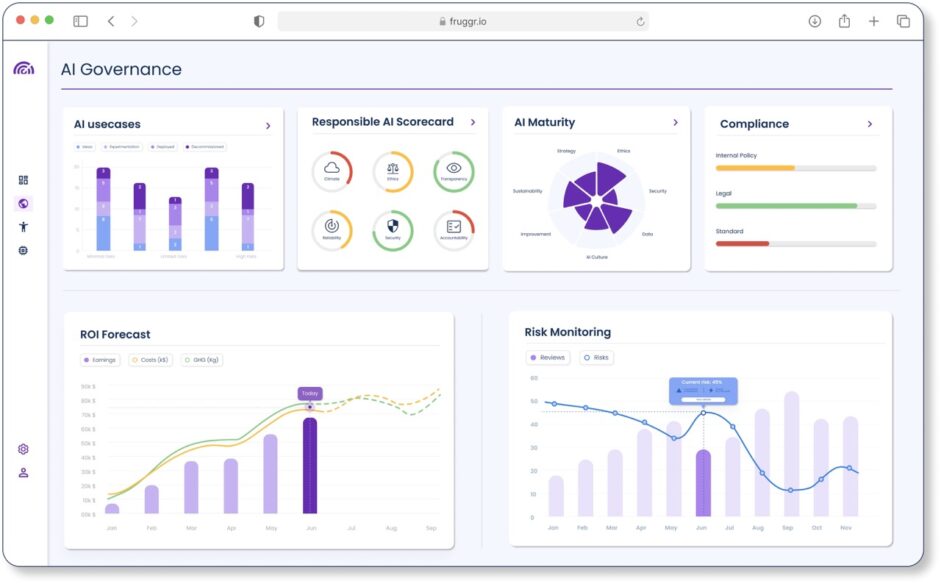
AI governance software is a category of platforms that give enterprises one system to inventory their AI models, assess and monitor risk, enforce policy, and produce audit-ready evidence for regulations like the EU AI Act, ISO/IEC 42001, and NIST AI RMF. The category spans narrow point solutions (inventory or risk-scoring alone) and full platforms (inventory plus risk, monitoring, and reporting together) — most enterprises outgrow a point solution within a year of buying one.
What AI governance software actually does (and doesn’t)
It doesn’t build your governance program for you. A tool can’t decide your risk appetite, name an accountable owner, or write your policy — those are organizational decisions (see Fruggr’s companion piece, “How to Build an AI Governance Framework“ ).
What software does is operationalize a framework once you have one: it turns “we should track every AI system we use” from an aspiration into a living, queryable register, and turns “we should monitor high-risk systems” from a policy line into an actual dashboard someone checks.
The honest failure mode buyers run into is treating the software purchase as the finish line. A platform with no framework behind it becomes an expensive, empty inventory — accurate data with no owner acting on it.
The core capability categories to evaluate
Every credible AI governance platform competes on some mix of five capabilities. Weight them by what your organization actually lacks today, not by which one a vendor demos best.
Point solution vs. full platform: which do you need?

A point solution
often just discovery/inventory, or just risk-scoring — makes sense when you’re early: you don’t yet know the scope of your AI footprint, and a narrow tool answers that one question fast and cheaply.
The tradeoff shows up within 6-12 months, once the inventory exists and the obvious next question becomes “now what do we do about the high-risk ones” — a question a pure inventory tool was never built to answer, forcing a second purchase, a second data model, and a manual bridge between two systems that don’t talk to each other.

A full platform
costs more upfront and takes longer to evaluate, but avoids that second purchase: the same system that finds your AI inventory also tiers its risk, enforces review workflows, and produces the audit trail — one data model, one source of truth.
The right call depends on where you actually are: if you don’t yet know how many AI systems you have, start with discovery and don’t over-buy; if you already have a rough inventory and the real gap is “we can’t prove any of this to an auditor,” a full platform closes that gap faster than assembling point solutions into a patchwork.
Questions to ask before you buy
Ask how the tool actually finds shadow AI — network/SaaS discovery, browser extension, procurement-record scanning, employee survey, or some combination — because a vendor that only ingests a manually-maintained list will miss most of what you’re trying to find in the first place.
Ask whether framework mapping (EU AI Act, ISO 42001, NIST AI RMF) is a native, maintained feature or a static PDF template that goes stale as regulations update.
Ask what happens to a system once it’s flagged high-risk — does the platform just label it, or does it route to an actual approval workflow with an owner and a deadline?
And ask for the data model behind multi-framework reporting: if inventory, risk, and reporting are three different modules bolted together (often the result of an acquisition), expect the same integration friction you were trying to avoid by buying a platform instead of point solutions.
Common mistakes when evaluating AI governance software
- Buying before defining risk tiers, so the platform has nothing to sort systems into and everything defaults to “medium.”
- Choosing based on the compliance frameworks you’re worried about today without checking how the vendor maintains mappings as those frameworks change — the EU AI Act’s own implementation timeline has already shifted once.
- Treating a slick discovery demo as proof the tool will catch shadow AI in your specific environment, when discovery methods vary widely in actual coverage.
- And skipping a proof-of-concept against your own messiest, least-documented AI use case — the clean example a vendor demos rarely resembles the shadow AI you’re actually trying to find.

Key takeaways
- AI governance software operationalizes a framework you already need to have decided on — it doesn’t replace the decisions of ownership, risk appetite, and policy.
- Evaluate against five capabilities — discovery, risk tiering, policy enforcement, monitoring, and framework mapping — weighted by your actual current gap, not the flashiest demo.
- Point solutions are the right early move if you don’t yet know your AI footprint; full platforms avoid the second-purchase problem once you do.
Next step: See how Fruggr’s AI governance platform covers discovery, risk tiering, monitoring, and framework mapping in one system — or request a demo to evaluate it against your own shadow AI footprint.
FAQ
No regulation or standard mandates a specific software product. What they require — an inventory, risk assessments, monitoring, documented evidence — is achievable manually at small scale, but software becomes practically necessary once you’re tracking more than a handful of AI systems.
General GRC (governance, risk, compliance) platforms cover risk broadly across an organization and often lack AI-specific capabilities like model inventory discovery or framework mapping to AI-specific standards. Purpose-built AI governance software trades some of that breadth for depth on AI-specific risks and regulations.
Initial discovery and inventory setup is often measurable in weeks; full maturity — risk tiering, enforced workflows, and audit-ready reporting across your inventory — is more realistic in 2-3 quarters, matching the build timeline in our AI governance framework guide.
It depends entirely on the vendor’s product architecture — some offer inventory as an entry tier with risk and reporting modules added later on the same data model; others are genuinely separate products under one brand. Ask directly rather than assuming either answer.
This article was drafted with AI assistance and reviewed by our editorial team before publishing.