

360° view of your AI systems:
unified and decision-making management
Centralize and control all your AI assets for strategic and operational governance

How to move from fragmented management to a global and actionable vision of your AI assets?
Organizations today face a proliferation of AI tools, models and uses, often siloed and poorly documented. Without an overview, they struggle to:
- Identify redundancies and hidden costs linked to similar solutions deployed in parallel
- Assess risks (security, compliance, performance) in a consolidated way
- Prioritize investments based on business value and regulatory challenges

Three critical challenges emerge:

Lack of visibility
Impossible to know which models are used, by whom, and for what results preventing any optimization or control

Siloed decisions
IT, data, legal and business teams work with scattered data, slowing innovation and increasing risks

Uncontrolled costs
and risks
The absence of global monitoring leads to unnecessary expenses (cloud, licenses, maintenance) and greater exposure to security or compliance vulnerabilities
Our solution:
A 360° AI management platform
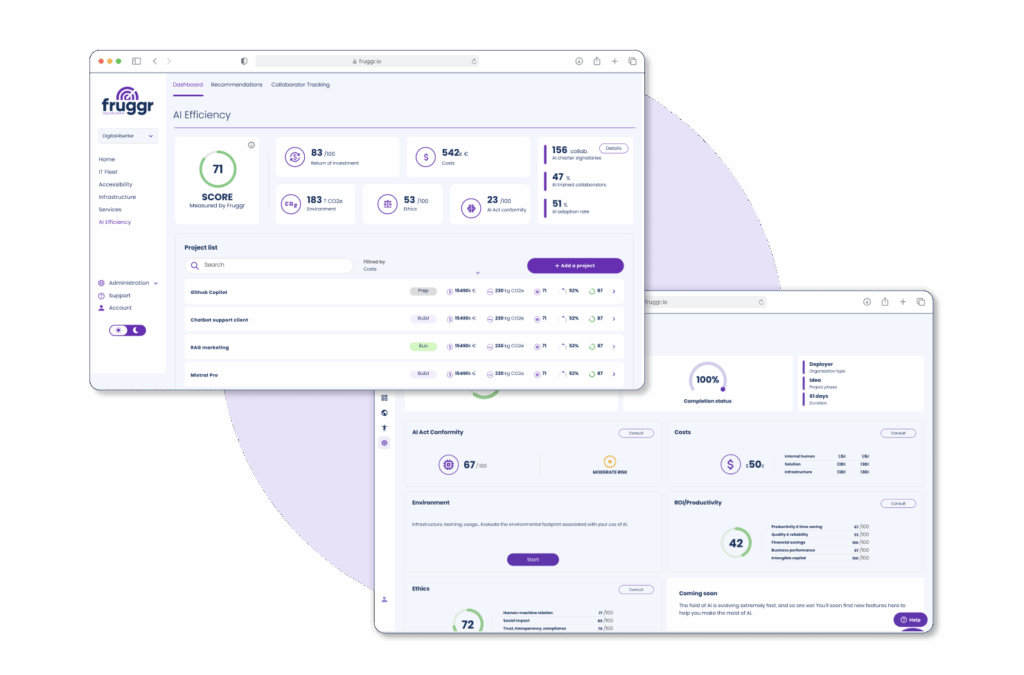
Fruggr provides a unified, real-time view of all your AI systems, integrating technical, financial, regulatory and operational data
Our key features
- Centralized inventory:
List all your AI assets (internal models, SaaS, open source) in a single registry, with their metadata (owner, usage, costs, risks)
- Customizable dashboards:
Visualize at a glance the performance, costs, carbon footprint and compliance of each system
- Cross-analysis:
Identify correlations between usage, ROI, risks and compliance for informed decisions
- Smart alerts:
Get notified in case of drift (cost, security, non-compliance) or optimization opportunities
Your benefits

Full control over your AI assets:
A single source of truth to manage your investments and reduce waste

Decisions aligned with strategy:
Prioritize projects based on their business, regulatory and environmental impact

Cost and risk reduction:
Lower AI spending by eliminating redundancies and optimizing resources
